
Chinese heritage · Individual expression
The qipao.
A silhouette with a story.
A standing collar. Beautifully framed edges. A line that follows the body. Few dresses make such a distinctive impression with so few elements.
Known as qipao in Mandarin and cheongsam in Cantonese, this modern Chinese dress brings together craft, elegance and a century of reinvention.
Explore the story at London Museum ↗
Find your qipao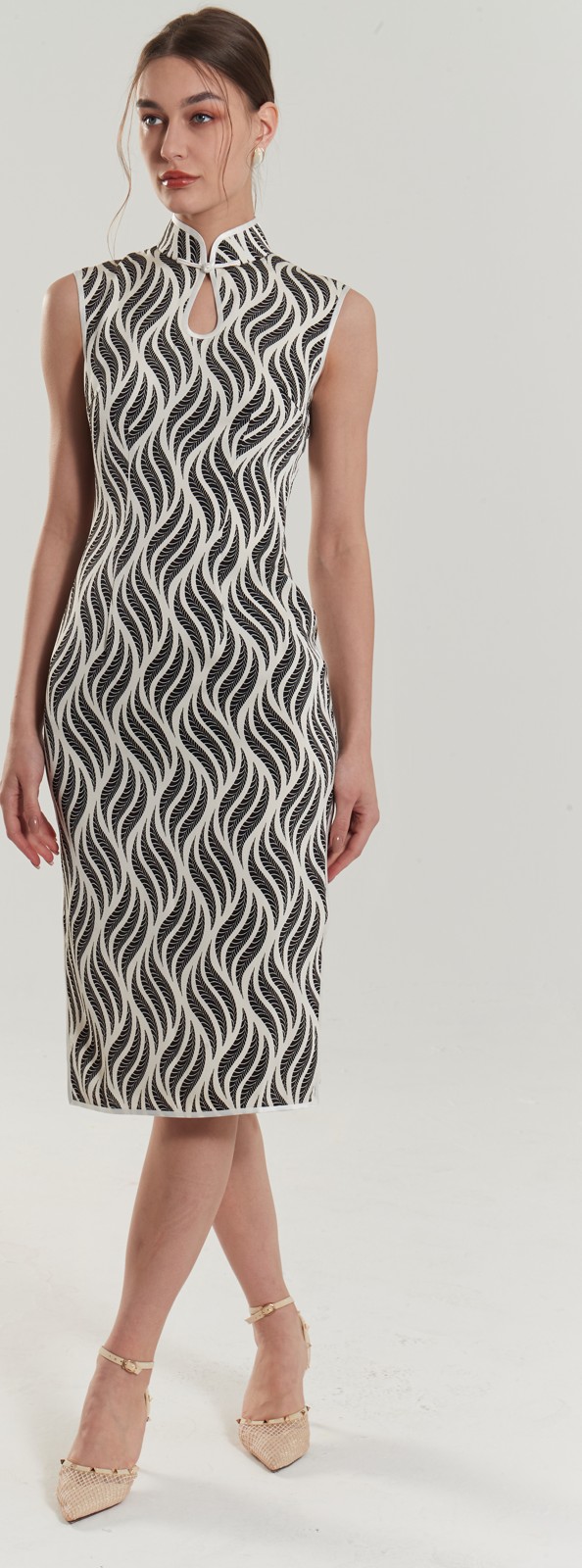
Anatomy of a qipao
Five details. One unmistakable dress.
Qipao designs vary, but these characteristic features give the dress its identity. The photographs below are details from our own collection.
These original photographs illustrate the styles and workmanship. Pictured fabrics are no longer available; your dress is made in a fabric you choose from our current stock.
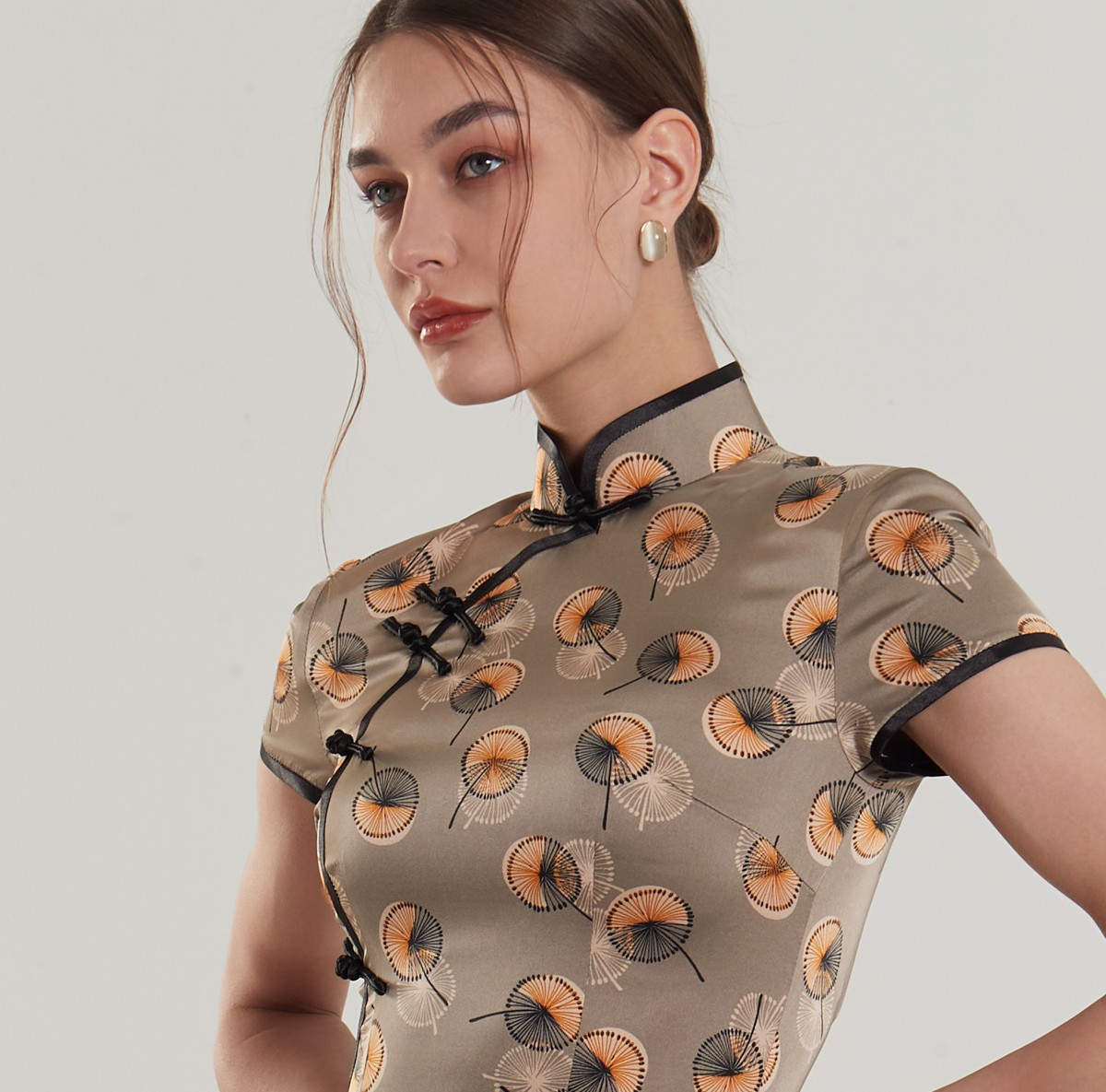
01 · Standing collar
A frame for the face.
The upright, or mandarin, collar creates a clean line around the neck. Its height, curve and finishing influence the whole dress: a small detail that can feel restrained, graceful or dramatic.
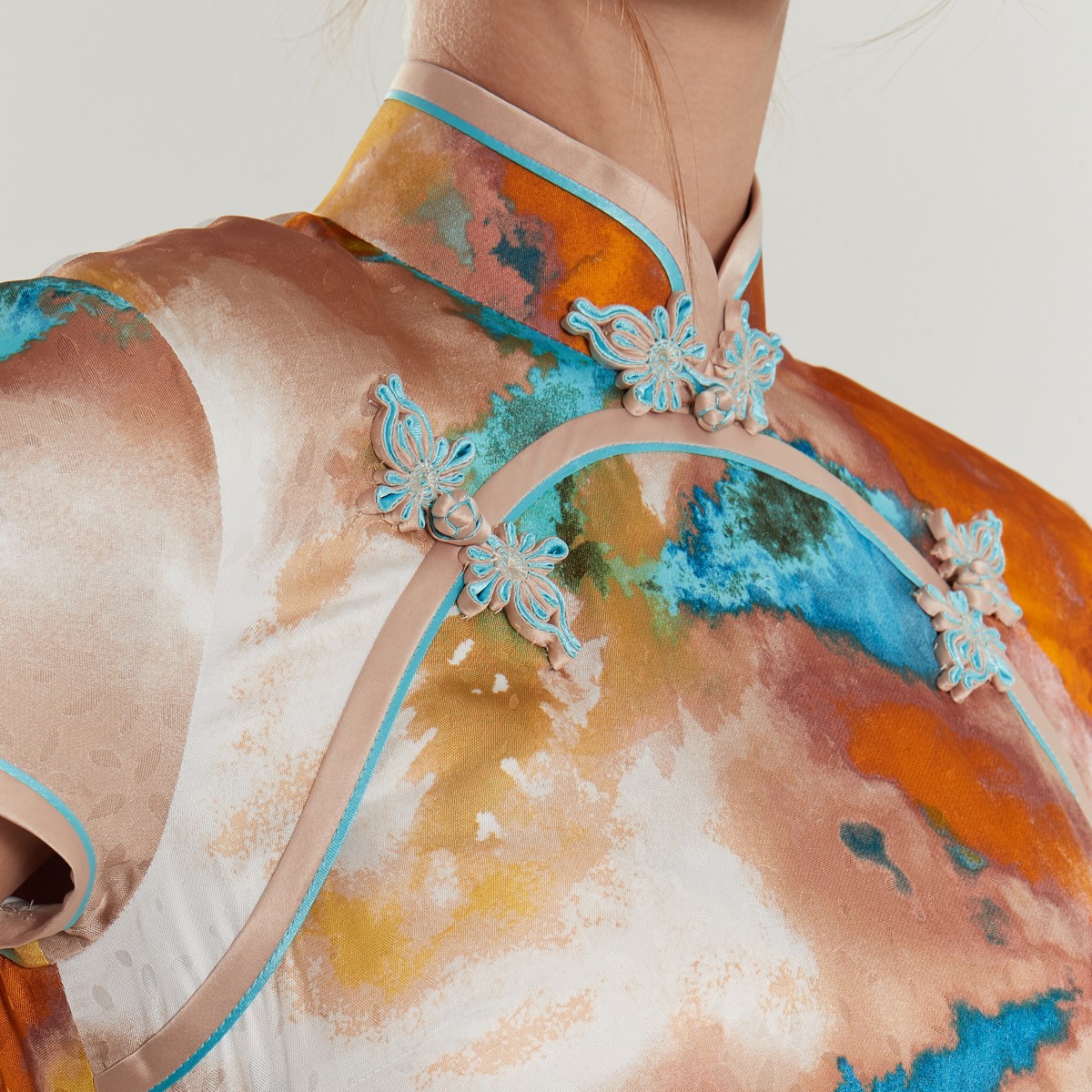
02 · Frog buttons
Fastenings with character.
Knotted buttons and matching loops, often called frog closures, add intricate detail at the collar and along the opening. Depending on the design, they can fasten the dress or serve as decoration alongside a concealed fastening.
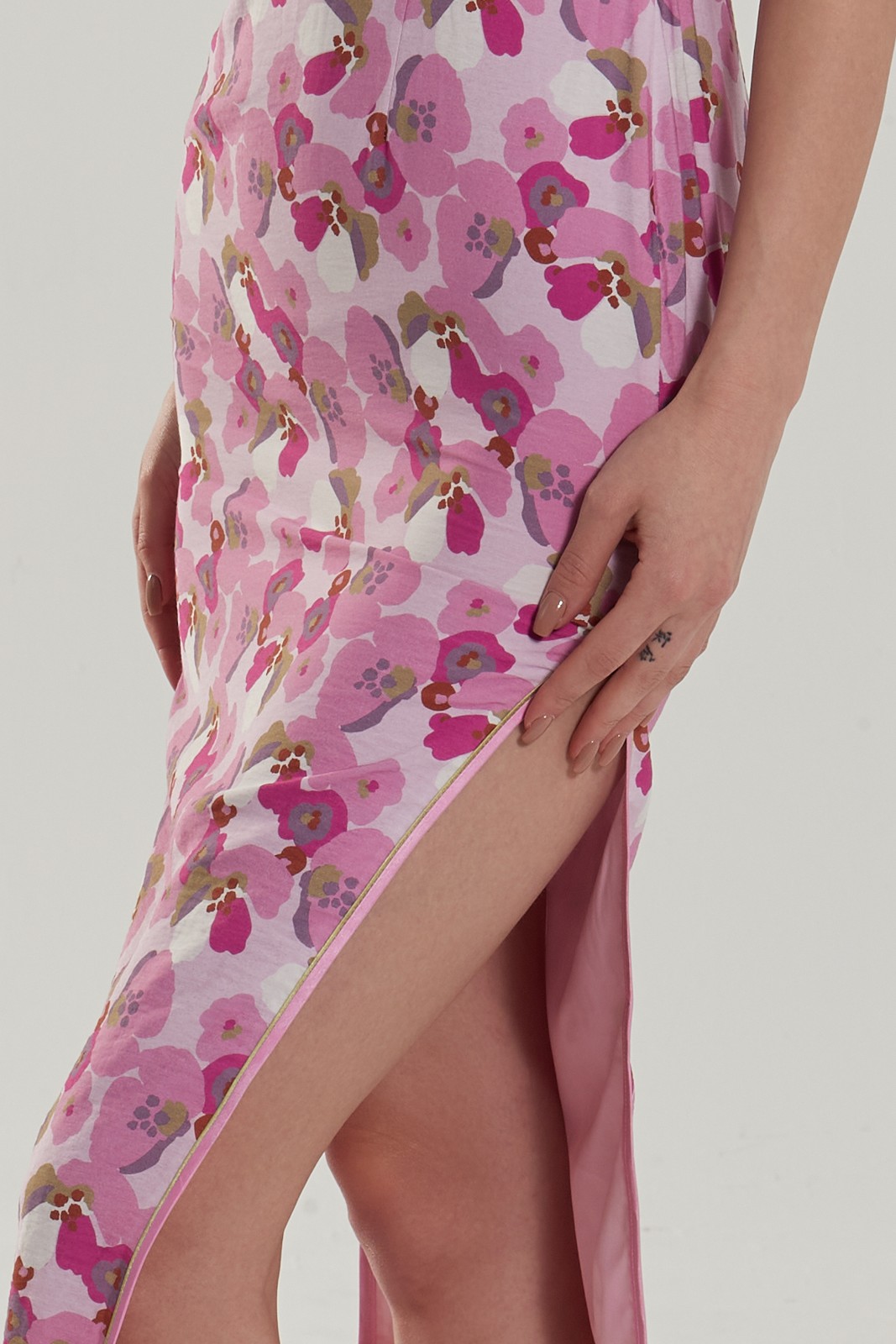
03 · Trimmed edges
The beauty of a finished line.
Piping or binding outlines the collar, armholes, opening and slits. A contrasting colour makes these lines graphic; a matching colour keeps them subtle. Carefully finished edges help give a qipao its polished appearance.
04 · Form-fitting silhouette
Shaped around you.
A qipao follows the shoulders, bust, waist and hips to create a continuous, balanced line. Good fit should flatter your natural shape while leaving room to breathe, sit and move. Your body is the starting point.
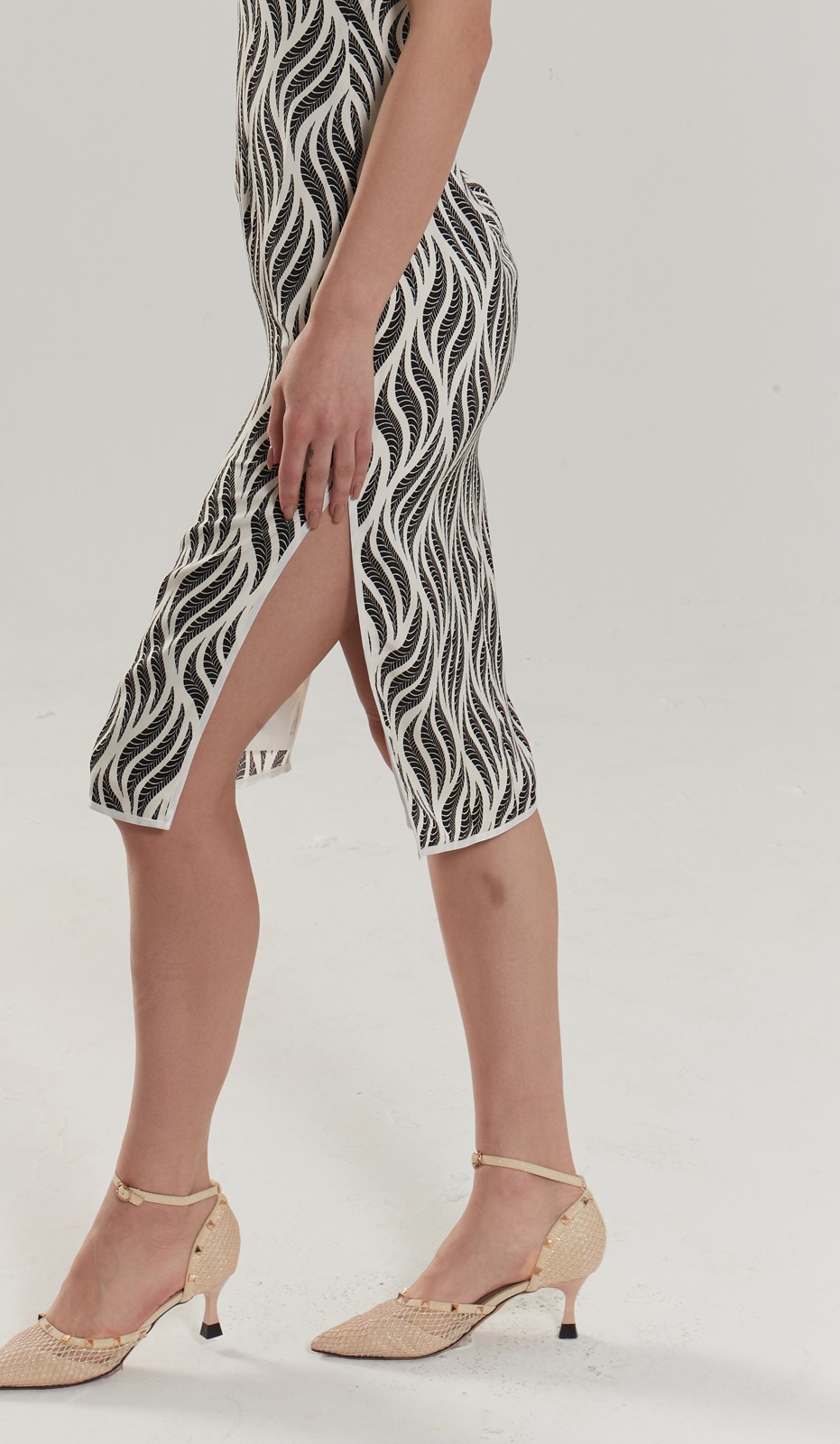
05 · The slits
Elegance in motion.
Slits let a narrow skirt move with your stride and reveal a different line as you walk. Their height changes the mood of the dress, from understated to striking.
Choose your slit preference and enter your desired dress length in inches or centimetres. The finished look should suit your occasion and your comfort.
A brief history
From Shanghai modernity
to Hong Kong craft.
Early 20th century
The making of a modern dress
The qipao has connections to earlier Chinese robe traditions, including Manchu dress. Its familiar fitted form developed in the twentieth century; it is an evolving fashion, rather than an ancient garment preserved unchanged.
1920s–1930s · Shanghai
A new urban silhouette
The qipao became fashionable in Shanghai during the 1920s. In the following decade, Shanghai dressmakers incorporated Western tailoring techniques, including shoulder seams and closer shaping at the bust and waist. The result reflected a modern city open to international influences.
Mid-century · Hong Kong and beyond
A living tailoring tradition
Hong Kong became an important home for cheongsam fashion and craftsmanship. The dress also remained part of women’s wardrobes in places such as Taiwan and Singapore, taking on new fabrics, proportions and personal meanings.
Today
Heritage, worn your way
The qipao continues to be reinterpreted through contemporary prints, different lengths and individual styling. At Chinese Tailor, our family’s Hong Kong dressmaking tradition meets modern fabrics and your measurements. Our family is based in San Diego; our workshop remains in Hong Kong.
Read our family storyAcross the fashion world
A lasting international influence.
The qipao’s collar, closures and elongated silhouette have offered designers a rich vocabulary. Its influence sits within a broader exchange between Chinese aesthetics and Western fashion, explored by The Metropolitan Museum of Art in its 2015 exhibition China: Through the Looking Glass.
Saint Laurent · Fall 2004
Tom Ford’s interpretation
Ford revisited Yves Saint Laurent’s 1977 Chinese-inspired collection with fitted cheongsam silhouettes, silk, embroidered lace and vivid colour.
Louis Vuitton · Spring 2011
Marc Jacobs’s party wardrobe
Fringed cheongsams appeared in Jacobs’s exuberant collection, putting a familiar silhouette into a playful, theatrical eveningwear setting.
Gucci · Fall 2016
Alessandro Michele’s romance
A cheongsam-inspired gown with elaborate embroidery brought the silhouette into Gucci’s richly decorated world—and onto the red carpet on Margot Robbie.
In the spotlight
From the Oscars to the red carpet.
Celebrity fashion shows how differently these ideas can be worn. Some looks directly reinterpret the cheongsam; others draw more broadly on Chinese decorative traditions.
Nicole Kidman · Oscars, 1997
An unforgettable Dior gown
Kidman’s chartreuse John Galliano for Dior couture gown became a defining Oscars look. Its Chinese-inspired embroidery connects it to this wider fashion conversation, although the gown itself is not a traditional qipao.
Margot Robbie · Hollywood premiere, 2016
Gucci at The Legend of Tarzan
For the film’s Hollywood premiere, Robbie wore a Gucci silk gown with floral and bird embroidery. Its cheongsam-inspired shape and side slit show a more direct reinterpretation of the dress.
Alexa Chung · Featured in Vogue, 2016
A contemporary take on knot buttons
Vogue highlighted Chung in an Alessandra Rich dress with intricate knot-button detailing—a recognisable qipao reference translated into modern occasionwear.
Dua Lipa · Featured in Vogue, 2016
Long lines, bold styling
The same gallery featured Lipa in a long Alessandra Rich dress with a high slit, styled with bright pink heels. It is an expressive example of Chinese-inspired fashion worn with an individual point of view.
These independent fashion references illustrate the qipao’s wider cultural influence. The celebrities and fashion houses mentioned are not affiliated with Chinese Tailor.